



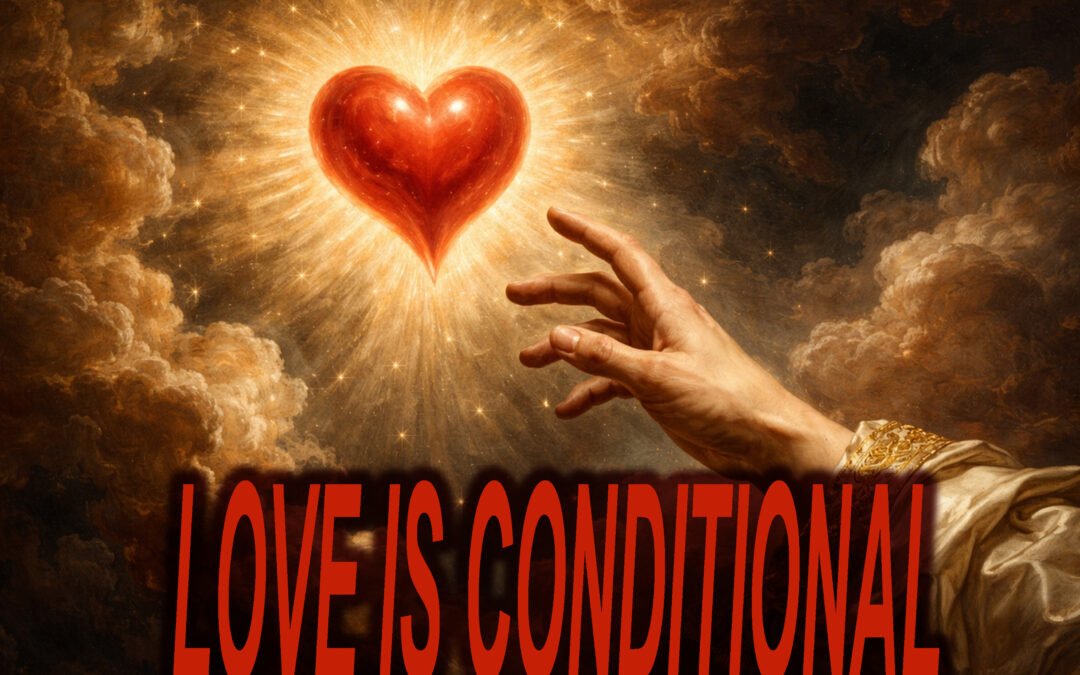
You didn’t expect to see this title one day, did you? Let alone read it on the website of someone who is supposed to advocate unconditional love? And yet, yes! This is what spirituality has taught me: unconditional love cannot exist. It can only be conditional and limited.
Our experiences of love
Here is a very brief and simplistic summary of the stages through which we experience love.
Childhood
From childhood, we learn that the love we receive depends on our mother and/or father. As infants, this love is said to be unconditional because it is without restrictions. Infants are weak and cannot fend for themselves, and love is the guarantee that someone will look after them. It has even been scientifically proven that showing weakness attracts love from others, or at least sympathy.
Around the age of two, we experience a new form of love: depending on whether our behaviour is deemed acceptable or not, we receive praise that we interpret as a sign of love. In our minds, pleasing others, being accepted and therefore being loved have become one and the same thing.
As we grow up, we increasingly understand that these signs of appreciation are due to our attitude. At first, our family is the framework that tells us, consciously or unconsciously, rightly or wrongly, that the love we receive from them depends on us.
But even children already have an idea of what they like and dislike. Whether innate or by choice, they will select what they enjoy and therefore like or dislike.
Who else had to fight with their parents because they hated fish but were still forced to eat it because ‘it’s good for you’?
Adulthood
As children, we encountered others. As adults, we are clearly aware that others have been taught codes that are sometimes similar to ours and sometimes different, and we experience moments that we either like or dislike.
Romantic relationships are a perfect example: our era so openly categorises whether a person has a ‘green flag’ or a ‘red flag’, meaning whether I like them or not based on their qualities, which are judged as positive or negative, or on what they bring to me (and I am among the most uncompromising).
Enfants, nous avons rencontré d’autres personnes. Adultes, nous sommes clairement conscients que les autres ont appris des codes qui sont parfois similaires aux nôtres et parfois différents, et nous vivons des moments que nous apprécions ou que nous n’apprécions pas.
Les relations amoureuses en sont un parfait exemple : notre époque catégorise si ouvertement qu’une personne a un « drapeau vert » ou un « drapeau rouge », c’est-à-dire si je l’aime ou non en fonction de ses qualités, qui sont jugées positives ou négatives, ou de ce qu’elle m’apporte (et je suis parmi les plus intransigeants).
Well-known examples of unconditional love
The world of spirituality is full of examples of men and women who embody unconditional love for all things. Was this really the case?
The Christ
Was it not Christ who, at the foot of Solomon’s temple, furiously drove out the merchants who were trading there? He had no love, or at least no acceptance, for these people who had made “his Father’s house a den of thieves. Matthew, XXI, 12-13.” Where is the unconditional and tolerant love for these merchants?
Buddha
It is said that Buddha, despite having attained spiritual enlightenment and being considered an example of unconditional love, showed exasperation when monks distorted his teachings. He could have shown tolerance and sought to understand if the distortions were not due to a lack of understanding, despite good intentions.
Mother Teresa
Mother Teresa, it was said, had unconditional love for the seriously ill and dying. Journalist Christopher Hitchens denounced the fact that she repeatedly told patients that their suffering was normal because they were not “pious” enough in the eyes of God. Where is the line between piety and fanaticism?
These so-called “spiritual” people
Let’s be honest with ourselves again (myself included): those who have a spiritual practice, who claim to be enlightened, open-minded, and tolerant, are the least tolerant and most likely to reject what they don’t like, whether it be based on values, self-opinion, or “vibrational sensitivity.”
In our hearts
And there is another phenomenon: we don’t like ourselves. We reject certain characteristics in ourselves, either because of social conventions, beliefs, or because, as individuals, we want to be someone else, someone better than the person we are in everyday life.
We can’t help acting this way. It’s stronger than us.
So…
UNCONDITIONAL LOVE, WE ACCEPT EVERYTHING AND WE ARE ACCEPTED NO MATTER WHAT WE ARE, IS A LIE. WE ALL HAVE LIMITS AND WE ALL EXPERIENCE LIMITS. EVERYONE.
.
Good news: this limit is the solution to our lack of love.
Whether it takes the form of appreciation, compassion, or importance, we want to love and, above all, be loved. We all desperately lack love.
And everyone has criteria in their conscience that they categorize as likable or detestable.
I regularly see people in sitting who complain about this lack of love but who do not love themselves. Silly question: how can we expect others to love us in these circumstances?
Energy healing was taught to me in the following way: it is a connection to the vibration of love. However, I saw that this practice had a limitation: the person needed to be open to the vibration of love.
So they should learn to love and accept themselves as they are, shouldn’t they?
No. They cannot love themselves as they see themselves and as they think they are. They cannot do it, and rightly so. They need to go through a period of introspection, either in therapy or on their own.
What is the solution?
Become the kind person. Be the person who loves and is loved for their inner identity.
People then rightly reply that they have done everything they can to be loved, but to no avail. Again, they are right. It is not a question of action but a question of mindset.
LA QUESTION N’EST PAS COMMENT FAIRE POUR ÊTRE AIMÉ MAIS QUI JE SUIS LORSQUE JE SUIS AIMÉ ?
By “who,” I mean essentially everything that makes up the embodiment of an identity:
• Behaviors,
• Mindset,
• Actions,
• Self-perception,
• Etc.
When I ask this question, people in counseling tell me about their ideal version of themselves. For example, “I am a good person, I am cheerful, I am very successful, I am strong, I am slim, etc.” or actions such as “I always help my loved ones, I am cheerful with everyone, etc.”
I then ask them what the state of mind is in this love, and they struggle to answer. That makes sense. This ideal version is generally far removed from their reality. I then ask them to tell me about this version in detail. In short, what they are not in the present moment…
I ask them what details their ideal version has. Then, based on those mentioned, they already embody one or even several; or, if not, what trait is REALISTIC AND SIMPLE for them to embody. For example: “I can start smiling, I can learn to meditate, I can start doing a simple gesture to help others, etc.”
People almost always mention an action to me. That’s perfect! Repeating an action frequently anchors the feeling of love and helps you fully embrace it. Meditating, helping others, improving yourself, and being a parent to yourself are among the most commonly cited examples.
BY FULLY EMBRACING THIS NEW FEELING, THE PERSON TAKES ON A NEW IDENTITY: THAT OF BEING A VIBRATION OF LOVE.
Worthiness
The main problem I encounter—and the most taboo—is the question of merit. I usually ask the following question: what proof do they have that they are already worthy of this much-desired love, or that they can become worthy of it?
Asking yourself these questions on a personal level allows you to find ways to gradually, consistently, and effectively anchor this vibration of love.
And, with time, by changing their outlook or attitude, the flaws rejected in themselves or in the outside world fade away and they end up fully embracing this love.
Conclusion
This is the main lesson I have learned from my spiritual journey: not everything can be loved. Thanks to this, our consciousness knows what allows us to become the best version of ourselves. Conditional love is the solution to truly opening ourselves up to love and becoming a man or woman blessed with love. Thus, based on a change in perspective and attitude,
THROUGH SELF-TRANSFORMATION, LOVE IS FULLY ACCEPTED AND THEREFORE LIVED.
If you wish to deepen your relationship with self-love, you can explore it further through my sittings or myspiritual coaching“.